

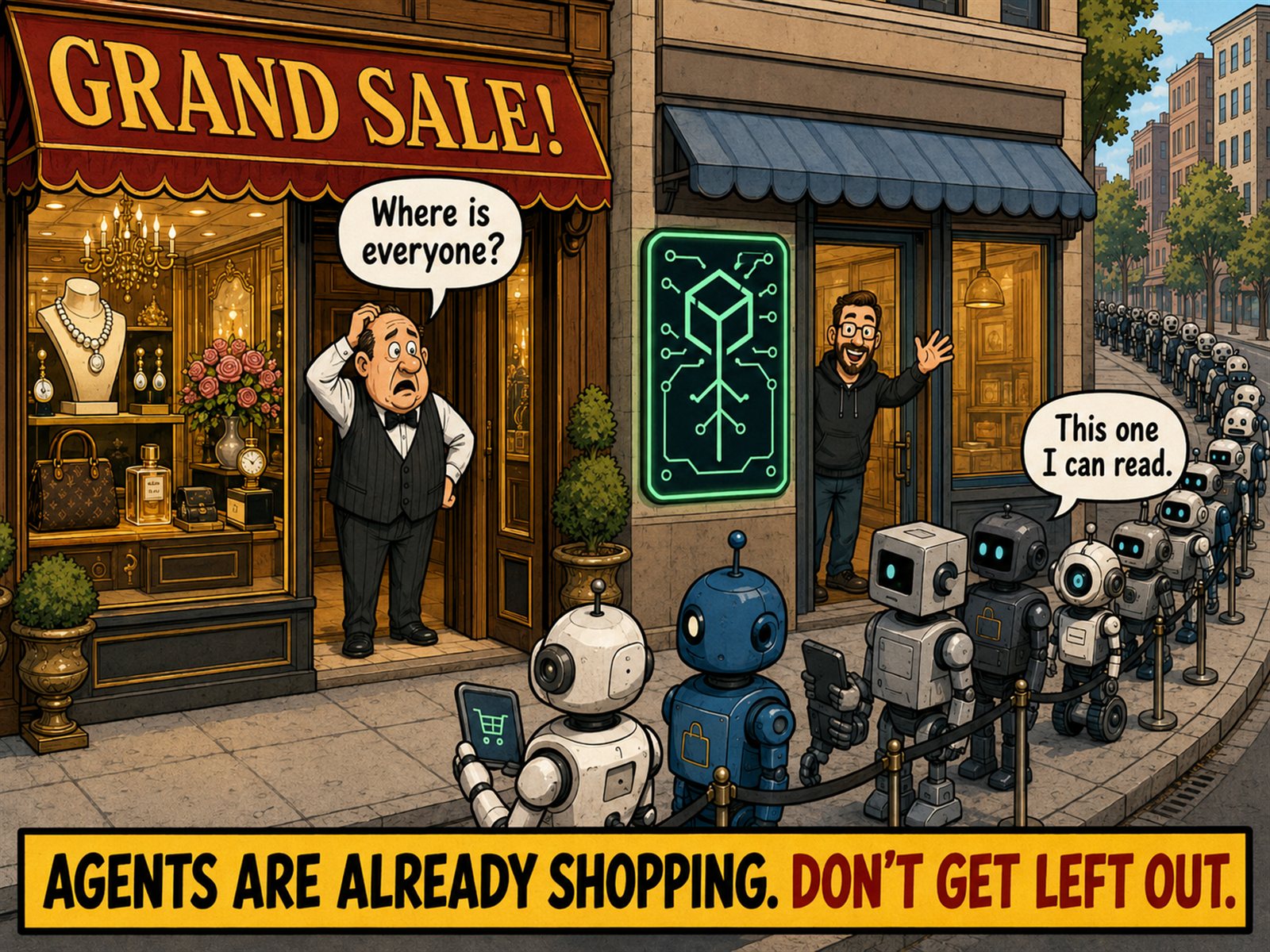
The Customer You Cannot See
Three numbers from the past year describe a customer most businesses have never designed for.
In June, Cloudflare reported that automated traffic passed human traffic on the web for the first time: 57.5 percent of requests. Over the 2025 holidays, Adobe Analytics measured AI-referred traffic to US retail sites up 693 percent year over year, converting 31 percent higher than other channels, with revenue per visit up 254 percent. Salesforce counted $67 billion of Cyber Week orders, a fifth of the total, as AI-influenced. The base is still small; the growth is not. Shopify's storefront sessions referred by AI grew eight times year over year in the first quarter, and orders thirteen times.
That traffic behaves differently. Shopify reports AI-referred sessions land directly on product pages two and a half times more often than search traffic. The agent does not admire your homepage, your hero video, or your carefully written About page. It arrives, checks, decides, and reports back to the person it works for. Your window display is being walked past by the one customer whose opinion now compounds: the software that decides what its principal ever sees.
What Catches an Agent's Attention
An agent's attention is not caught. It is qualified for. The mechanics are unglamorous and specific.
Structured data is the storefront. OpenAI's product feed spec for shopping agents defines 79 fields, 19 of them required, refreshable every 15 minutes. Google's agentic shopping requires Merchant Center attributes plus matching schema.org markup on the page, and when your feed and your page disagree about price or availability, Google deprioritizes both. Consistency is not a nicety; disagreement between your own surfaces reads, to a machine, as unreliability.
Published, checkable facts beat persuasion. An agent can verify a price, a return policy, a delivery window, and a stock level. It cannot verify "premium quality." Every claim you publish in checkable form is a field the agent can score you on; every "call for pricing" is a field left blank, and blank fields lose to filled ones silently, in milliseconds, with no bounce report.
And skip the folklore: llms.txt, the much-promoted "file for AI," is largely ignored in practice. An Ahrefs study found 97 percent of published llms.txt files received zero requests in a month. The feeds, the schema, and the page itself are what the machines actually read.
The Storefront Agents Can Walk Into
The next layer is letting agents act, not just read, and a standard for it now exists. WebMCP, drafted at the W3C by Google and Microsoft engineers, lets a website expose real tools, search this catalog, add to cart, check out, that a browser-based agent can call directly in the shopper's own session instead of fumbling through your buttons. It is early: a community draft, running as a Chrome origin trial, with no other browser committed. But it stopped being theoretical on August 5, when Shopify switched WebMCP on for every one of its storefronts, no merchant action required.
Early is the point. Of 22,341 domains scanned in July for the agent-discovery files that the A2A protocol defines, 65 had one. Being legible to agents today puts you in a fraction of a percent of the web, for roughly a day of work. This site practices what it preaches: our own pages serve MCP tools, an agent card, and a machine-readable service catalog, and our companion article, "WebMCP: Making Your Website Agent-Native," covers the implementation details.
Honesty about the messy middle: the rails are still being fought over. OpenAI's in-chat Instant Checkout retired in March after only about 30 merchants went live, and ChatGPT moved back to discovery with checkout on the merchant's own site. Google's Universal Commerce Protocol is expanding on exactly that model. Amazon and Perplexity are in court over whether an agent acting on a user's instruction counts as the user or as a blockable bot. So the near-term play is rail-agnostic: be findable and checkable by every agent, keep checkout on ground you control, and avoid welding yourself to any single platform's protocol while the fight settles.
Gateway Now, Attention Later
Today the agent is the gateway to its principal's attention. It reads everything, shortlists a few, and the human chooses from the shortlist. You now sell twice: machine-legible to get considered, humanly distinctive to get chosen. Both sales are real, and the first one is new.
The longer arc is that the agent becomes the primary attention. Gartner forecasts AI agents will intermediate 90 percent of B2B buying by 2028. Consumers are slower to hand over the final click, about 11 percent will let an AI complete a purchase today, but roughly three in ten already let AI narrow their choices, and the major forecasts converge on 10 to 25 percent of US online retail being agent-mediated by 2030. When the reader of your marketing is mostly software, your brand becomes your data quality, your verifiable track record, and the consistency of what you publish. The businesses that treated agent traffic as bot noise to block will discover they blocked their customers' buyers.
What to Do, With Dates Attached
- This month: audit yourself as an agent sees you. Is your schema markup complete and consistent with your pages? Are prices, policies, and availability published and checkable? Fix disagreements first; they are silent disqualifiers.
- This quarter: instrument your agent traffic. You are already being evaluated; find out by whom and how often before you decide anything else. If you sell on a platform, check what it switched on for you; Shopify merchants got agent-facing storefronts and WebMCP this year by default.
- Within six months: decide your rail posture, discovery everywhere, checkout on your own ground, and publish a machine-readable catalog of what you sell. If an agent cannot enumerate your offerings, to that agent you do not exist.
- Ongoing: keep the human layer excellent. The shortlist still ends with a person, and the agent cannot yet be charmed, but its principal can.
The gateway to your customers' attention is changing hands. The good news is that almost nobody is standing at the new door yet.
Agentic Solutions makes businesses legible to the agent economy: feeds, schema, MCP tooling, and the strategy for selling to a buyer that reads everything. Our own site runs it all in production. Start the conversation.