

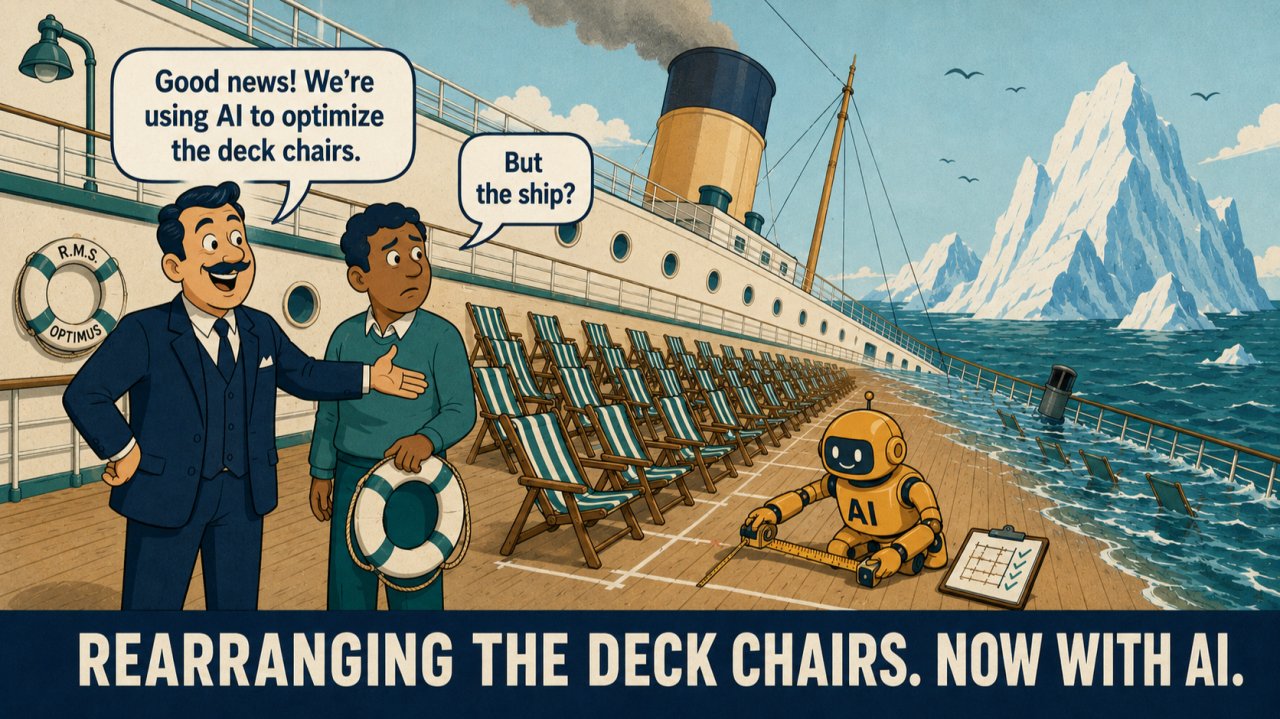
Why "Just Use AI" Has Not Transformed Your Work
If you have been told to use AI and found that it did not transform your work, that experience is not a personal failing. Working alone, any individual can improve only the work contained within their own role. Tasks can be sharpened and routine work handed to a tool, but the improvement reaches a ceiling at the boundary of the role itself. That ceiling is structural, and it applies to everyone equally.
The evidence is consistent on this point. The largest early study of AI among customer-service staff found an average improvement of roughly 14%, with little benefit for the most experienced workers. In a controlled study, experienced software developers using AI completed familiar work more slowly while believing they had gone faster. A capable tool placed on an unchanged role produces a small result that additional effort does not materially change.
An Illustration from Manufacturing
Manufacturing offers a clear illustration of why this is so. A production line's output is not raised by running one station faster while everything around it stays the same. Output is governed by the design of the whole line: the sequence of steps, the handoffs, the work waiting between stations, and the effort spent keeping it all coordinated. A real gain requires changing the line itself.
Office work behaves the same way. A substantial improvement comes from redesigning the entire flow of work, and no single person can accomplish that from inside their own role. The improvement lives in the structure rather than at any individual desk.
How the Work Is Actually Being Reorganized
The organizations achieving large gains from AI have not done so by having employees use it more. They have reorganized, and notably they have reorganized toward smaller teams rather than larger ones. The recurring pattern is a small group, often a handful of people, given real permission to own a result from beginning to end: to work out what is needed, to build and deliver it, and to confirm whether it worked. AI handles the scaling and the routine work that once required additional staff, which lets a small team reach a finished result faster and take on far more than its size used to allow.
This pattern is not new, and it is worth knowing that it predates AI by decades, because that tells you the model is proven rather than fashionable. In 1943, Lockheed handed a small team complete authority over a single goal and almost no bureaucracy, and that team built the first American jet fighter, from idea to flying prototype, in 143 days. Amazon later built much of its business on what it called two-pizza teams, small enough to be fed by two pizzas and accountable for a whole outcome. Buurtzorg, a Dutch home-care provider, organizes its roughly fifteen thousand nurses into self-managing neighborhood teams of no more than twelve, with no managers, and delivers lower costs and higher patient satisfaction than far more layered competitors. The common thread across all of them is a small team trusted to carry something all the way through, and to do it quickly.
Smaller teams hold a structural advantage. Each additional person multiplies the connections, meetings, and handoffs required to stay aligned, and that burden grows quickly. Studies of office work find the average person spending close to 60% of the day on coordination of this kind: meetings, status updates, searching for information, and managing shifting priorities, which leaves roughly a quarter of the day for the skilled work they were hired to do. Large teams absorb much of any productivity gain in this overhead, while small teams retain it.
Positioning Your Own Contribution
This points to a practical way to think about your own position. Security tied to specific tasks is fragile, because tasks are precisely what gets automated, accelerated, and reassigned. Security tied to your contribution to what the organization actually delivers is considerably more durable. The useful question is where, within the product or service your organization sells, you make it materially better.
The people who do well in a structure built around small teams are those who can take responsibility for a complete outcome rather than a narrow task, and who can carry something from a rough idea through to a delivered, working result. Adjusting how you regard your own work, moving from a set of assigned tasks to ownership of a portion of the result, is the change that carries across any reorganization an employer might undertake.
Whether Your Organization Will Change
There is a further consideration worth weighing honestly, and it concerns your organization rather than you. The tools required for this change already exist, and the methods are increasingly well documented. Whether an organization actually adopts them depends far less on access than on will.
Manufacturing history is instructive here. For years Toyota openly showed competitors its production system, and in the 1980s it operated a joint plant with General Motors that placed those methods directly in American hands. The information was available. Most American manufacturers still required the better part of a generation to adopt practices of comparable depth, because doing so demanded changes to roles, authority, and workflow that they were reluctant to make. The obstacle was organizational will rather than knowledge. The same will now determines which organizations reorganize around AI and which do not.
It is worth observing your own organization carefully. Does leadership remove obstacles and reconsider how work is structured, or does it set usage targets and expect individuals to supply the rest? The answer indicates a great deal about where your effort is best directed, and whether the environment around you is likely to change or to remain as it is.
Practical Next Steps
- Identify where you contribute to the value the organization delivers, expressed in terms of the product or service rather than the tasks on your list.
- Seek or propose ownership of a small, complete outcome from beginning to end, rather than responsibility for a slice of a larger process.
- Develop genuine fluency in delegating real work to AI, practiced on actual outcomes rather than trivial tasks, so that you can judge the quality of the output and direct the tools rather than merely operate them.
- Read your organization's will accurately, using the signals described above, and calibrate your expectations and decisions accordingly.
- Keep your contribution portable. If your organization proves unwilling to make the necessary changes, the ability to own outcomes and direct AI moves with you to one that will.
The fear of replacement assumes that a job is a fixed list of tasks and that a machine will take the list. A role has always been more than the list. It is the value a person adds to something others pay for. Tasks change, tools change, and the structure is redrawn, yet a contribution to the result, once you learn to own a portion of it, remains yours.
Agentic Solutions helps organizations move past "just use AI" by redesigning how work flows and unleashing the small, capable teams that turn AI into measurable results. Start the conversation to see what is possible.