

The AI industry is split between two camps: believers in full autonomy and skeptics who see AI as overhyped. We occupy the pragmatic middle—and our production systems prove why hybrid architectures win.
The Problem with Pure Approaches
Pure AI systems promise intelligent automation but deliver unpredictable results. They hallucinate. They miss edge cases. They make confident mistakes. Put them in production and you'll spend more time debugging than the automation saves.
Pure deterministic systems are reliable but inflexible. They handle the happy path perfectly and break on everything else. The world is messy; rigid rules can't handle it.
The answer isn't choosing one or the other. It's fusing them intelligently.
The Three-Layer Architecture
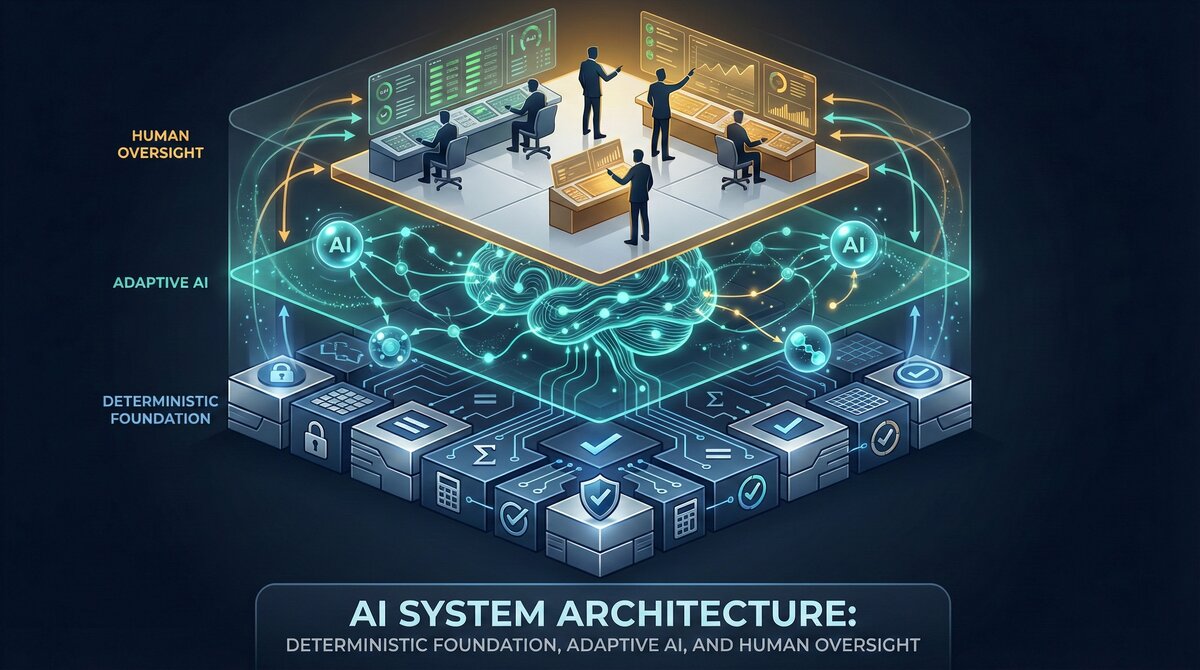
We build systems with three distinct layers, each doing what it does best:
Layer 1: Deterministic Foundation
The base layer handles everything that must be precise:
- Compliance validation
- Financial calculations
- Safety protocols
- Audit logging
- Data integrity checks
These components don't "learn." They execute with 100% consistency. When you need 2+2 to always equal 4, you don't ask an AI—you use deterministic code.
Examples: Approval workflows, regulatory compliance checks, pricing engines, transaction processing.
Layer 2: Adaptive AI Layer
On top of the deterministic foundation, AI agents handle reasoning, adaptation, and optimization. They:
- Recognize patterns across complex data
- Synthesize information from multiple sources
- Handle nuance and context
- Adapt to new situations
- Orchestrate deterministic tools intelligently
But here's the key: they operate within guardrails defined by the deterministic layer. The AI can reason about which compliance check to run, but it can't override the check itself.
Examples: Vendor negotiation, demand forecasting, content generation, intelligent routing, anomaly detection.
Layer 3: Human Oversight
Humans maintain strategic control. The system:
- Escalates edge cases that fall outside normal parameters
- Provides transparency into AI reasoning
- Allows override at any point
- Captures human decisions as training data
This isn't AI replacing judgment—it's AI handling volume so experts can focus on exceptions.
Examples: Exception handling, strategic decisions, model retraining approval, policy updates.
Why This Works
Reliability Where It Matters
The deterministic layer never guesses. Compliance checks always run. Calculations are always correct. Audit trails are always complete. You get the reliability of traditional software where you need it most.
Intelligence Where It Helps
The AI layer handles what rules can't: understanding context, recognizing patterns, adapting to novel situations. It makes the system smart without making it unpredictable in critical areas.
Humans in Control
Your team retains strategic oversight. They're not watching every transaction—they're handling the exceptions that require human judgment. Their decisions feed back into the system, making it smarter over time.
The Learning Loop
The architecture isn't static. It improves continuously:
- AI handles routine cases based on current patterns
- Edge cases escalate to humans for judgment calls
- Human decisions become training data for the AI layer
- Patterns that stabilize can move to deterministic rules
- New edge cases surface and the cycle continues
Your competitive advantage compounds with every cycle. The system gets smarter about your specific business, your edge cases, your operational reality.
Implementation Principles
Start with the Deterministic Core
Don't try to AI-enable everything at once. Identify what must be reliable and build that first. Compliance, safety, data integrity—these are your foundation.
Add AI at Natural Decision Points
Look for places where human judgment currently creates bottlenecks. These are your AI opportunities. The goal isn't automation—it's augmentation.
Design for Transparency
Every AI decision should be explainable. When something goes wrong (it will), you need to understand why. Black boxes don't survive production.
Build Escalation Paths
Not every decision should be automated. Design clear criteria for when the AI should escalate to humans. Make it easy for humans to override.
Instrument Everything
You can't improve what you don't measure. Track confidence scores, escalation rates, human override patterns. These metrics drive continuous improvement.
The Result
A system that:
- Runs reliably because reliability is built into its foundation
- Adapts intelligently because AI handles reasoning within guardrails
- Keeps humans in charge of the decisions that matter
- Improves continuously as it learns from operations
This isn't the future. This is how we build production systems today. The technology is ready. The question is whether your architecture is designed to use it.
Ready to explore how the three-layer architecture could work for your operations? Start a conversation with our AI assistant or reach out directly.