

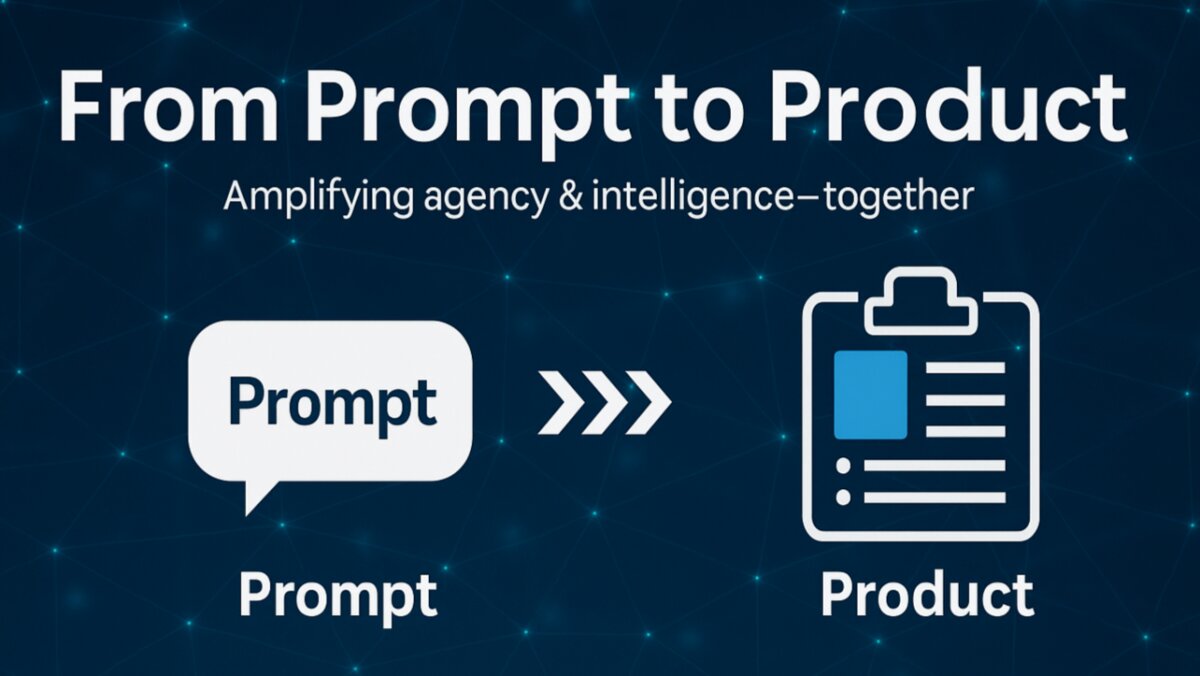
Large-language models operate within mathematical "latent spaces," where prompts function as navigation pathways. Modern AI systems like OpenAI's o3 and o4-mini-high can chain multiple operations—browsing, scraping, analyzing, reformatting—before delivering finished outputs, distinguishing them from legacy models that return single text responses.
Why Latent-Space Literacy Beats Prompt Hacks
Harvard Business Review warned that quick-fix prompt techniques plateau, while systematic literacy produces compounding returns. McKinsey data indicates 71% of organizations now employ generative AI, establishing a clear priority: develop strategic prompt design rather than accumulating workflow integration tools.
The difference matters because latent space navigation is fundamentally different from keyword optimization. You're not matching patterns—you're steering through a probability landscape toward outputs that don't exist until you call them into being.
A Live Demonstration
Here's a single prompt that demonstrates what's now possible:
"Analyze email marketing competitors' pricing pages. Visit Mailchimp, Klaviyo, and Brevo. Extract their pricing tiers, feature differentiation, and target customer segments. Identify gaps in the mid-market segment where pricing exceeds $500/month but lacks enterprise features. Generate a strategic response document from Klaviyo's perspective—how they might exploit these gaps."
The model independently:
- Visits each competitor site
- Extracts pricing data from dynamic pages
- Synthesizes insights across competitors
- Generates a strategic response document
No separate automation platform required. No API integrations. No data pipeline engineering. One sentence, delivered in under two minutes.
The Reusable Template
Here's the structure you can adapt:
[Task: Define the output you need]

[Research phase: Identify sources to investigate]
- Source 1: [URL or data type]
- Source 2: [URL or data type]
- Source 3: [URL or data type]

[Analysis requirements: What to extract]
- Data point 1
- Data point 2
- Comparison criteria

[Synthesis requirements: What to produce]
- Format: [Document type]
- Perspective: [Point of view]
- Focus: [Key insight areas]
The model handles navigation, extraction, analysis, and synthesis. You provide direction.
Future Applications
Sales Intelligence:
"Research [prospect company]. Visit their LinkedIn, recent press releases, and job postings. Identify their current tech stack, growth signals, and likely pain points. Generate a personalized outreach approach."
Operational Monitoring:
"Check the status pages and Twitter accounts of [critical vendor 1], [critical vendor 2], and [critical vendor 3]. Summarize any incidents from the past 48 hours and assess impact on our operations."
Talent Acquisition:
"Research compensation benchmarks for [role] in [market]. Visit Levels.fyi, Glassdoor, and LinkedIn Salary. Generate a competitive offer structure with justification."
The Literacy Investment
The organizations extracting real value from AI aren't the ones with the most tools—they're the ones who understand how to navigate the space.
Prompt hacks plateau. Latent-space literacy compounds.
Ready to develop systematic AI capability rather than accumulating point solutions? Our approach focuses on literacy that transfers across tools and models.