

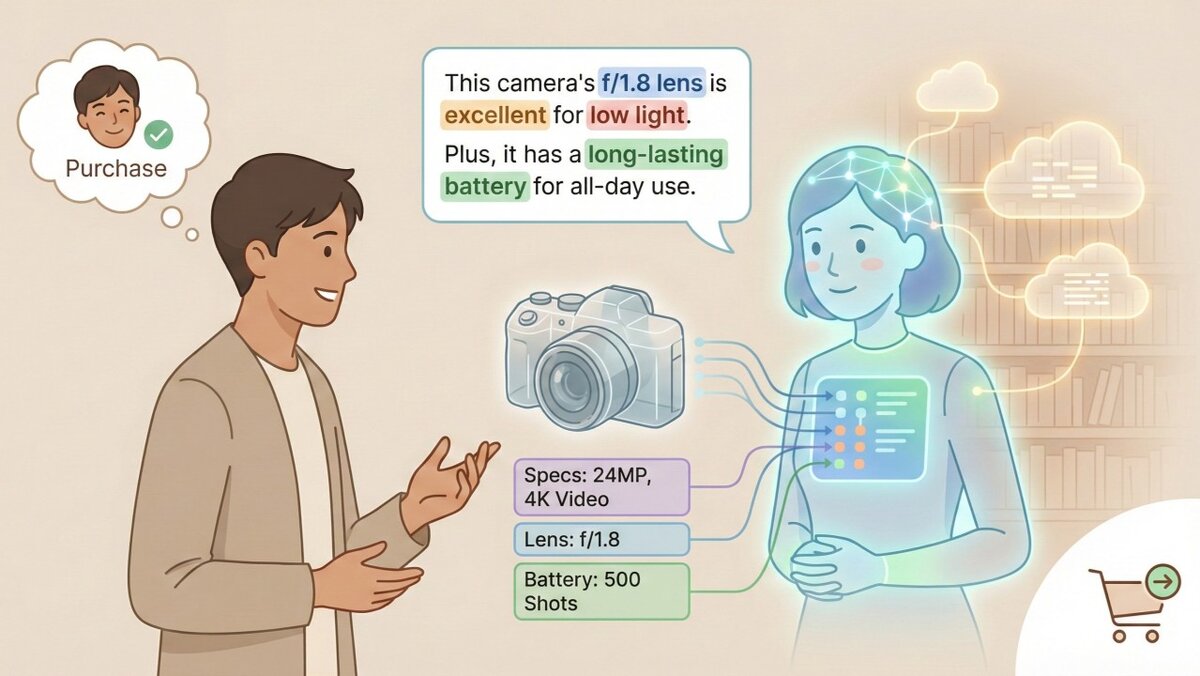
The shift from traditional SEO to Answer Engine Optimization (AEO) requires restructuring how brands present product data. Rather than optimizing for search rankings, companies must prepare their product information for AI agents that will recommend and sell products conversationally.
The Fundamental Shift
Product data is no longer just feeding a catalog—it's training the AI that will represent your products to customers. This represents a paradigm change from ranking-based models to recommendation-based models.
When an AI assistant responds to "I need running shoes for flat feet and wet conditions," it doesn't return a list of links. It makes specific product recommendations based on structured data. If your products lack rich, structured information about arch support, traction patterns, and water resistance, they won't be recommended.
New Merchant Center Attributes
Google has released several new attribute categories designed for AI consumption:
Commerce Attributes
- native_commerce
- merchant_item_id
- product_fee_type
Conversational Attributes
- common_question_answers
- compatible_accessories
- product_substitutes
Discovery and Catalog Attributes
Enhanced categorization and relationship mapping for AI-mediated discovery.
Common Question Answers Implementation
This is the highest-impact change you can make. Identify the high-frequency, high-impact questions customers ask about your products:
For running shoes:
- "How much arch support does this provide?"
- "Is it waterproof or water-resistant?"
- "How does sizing compare to Nike/Adidas?"
For kitchen appliances:
- "What's the noise level during operation?"
- "How does it compare to [competitor model]?"
- "What's included vs. sold separately?"
Structure these as Q&A pairs that AI agents can use directly in conversations. The agent doesn't have to infer answers from marketing copy—it has explicit, structured responses.
Description Rewriting Strategy
Your current product descriptions were written for humans scanning search results. AI agents need different content:
Traditional (for search):
"Experience ultimate comfort with our revolutionary CloudFoam technology. Perfect for runners who demand the best."
AI-optimized (for agents):
"8mm heel-to-toe drop. CloudFoam midsole rated for 500+ miles. Weight: 9.2oz (men's size 10). Arch support: neutral to mild pronation. Water resistance: DWR coating, not waterproof."
AI agents extract facts, not feelings. Specifications should prioritize explicit attributes and extractable facts over marketing language.
Agentic Acceleration
Traditional product data enrichment projects take 16+ weeks with teams manually updating thousands of SKUs. Using Claude Code and similar tools, we've compressed this to 8-10 days:
- Automated Q&A generation from existing product specs and reviews
- Relationship mapping between products, accessories, and substitutes
- Description reformatting for AI consumption
- Validation against Google's schema requirements
The same tools that are changing how customers shop can accelerate how you prepare for that change.
Implementation Roadmap
Phase 1: Audit (Days 1-2)
Analyze current product data completeness against new attribute requirements.
Phase 2: Q&A Generation (Days 3-4)
Generate common_question_answers for top 20% of SKUs (usually 80% of revenue).
Phase 3: Relationship Mapping (Days 5-6)
Map accessory compatibility and substitute products.
Phase 4: Description Rewriting (Days 7-8)
Reformat descriptions for AI extraction.
Phase 5: Notice Configuration (Day 9)
Configure consumer notices and compliance attributes.
Phase 6: Validation (Day 10)
Validate against schema requirements and test in sandbox environments.
Phase 7-8: Rollout and Optimization
Deploy changes and monitor AI agent interaction metrics.
The Compound Advantage
Brands investing in AEO capability now will compound advantages as AI-mediated commerce scales. When Google Business Agent launches with major retailers, when Microsoft Copilot Checkout expands merchant partnerships, when OpenAI's shopping capabilities mature—you'll be ready.
The brands that will dominate conversational commerce are the ones preparing their product data today, not the ones waiting for the market to mature.
Ready to structure your product data for AI agents? Our team can assess your current state and build a roadmap for AEO readiness.