

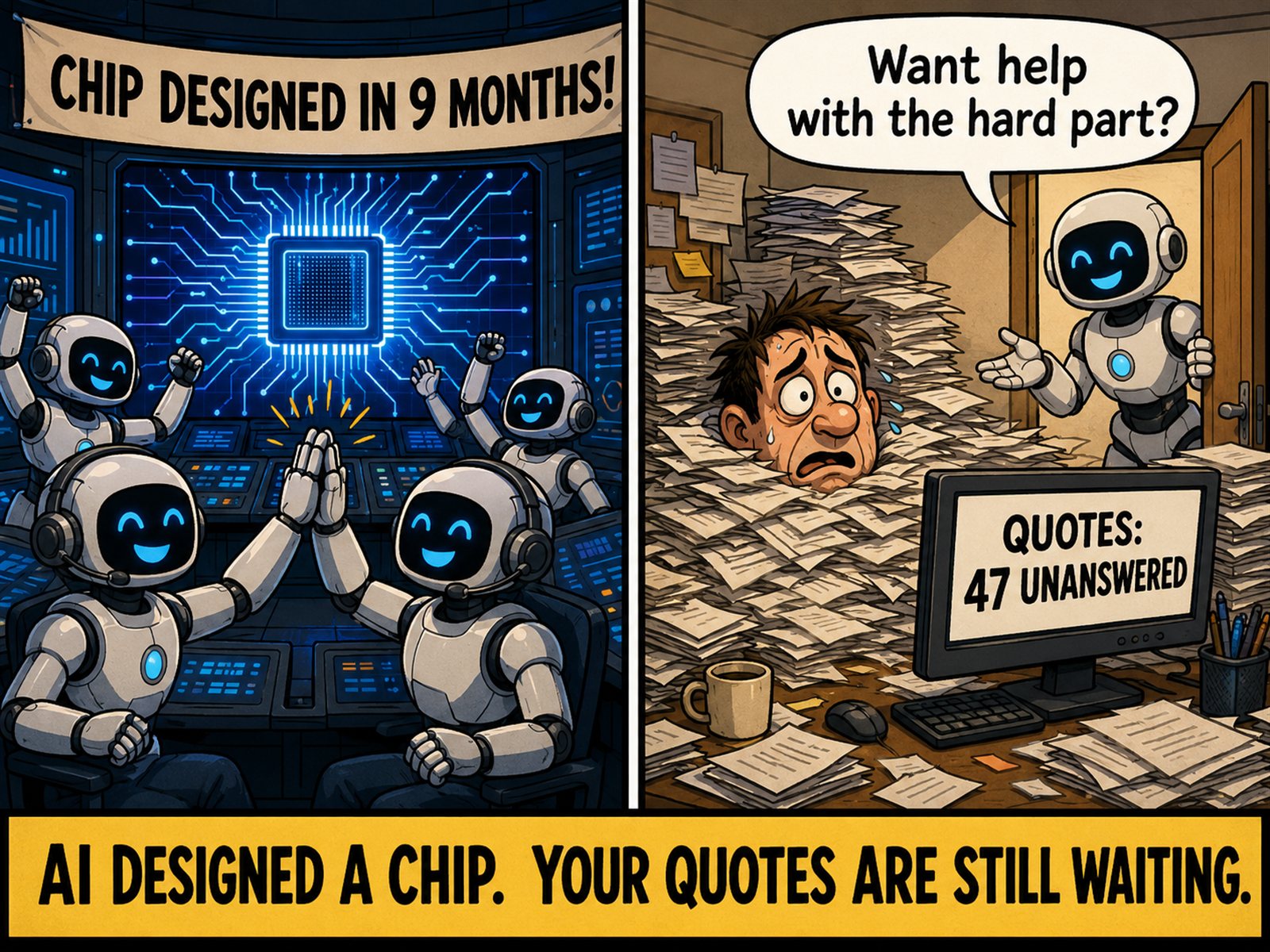
Eleven Thousand Emails a Day
C.H. Robinson, one of the largest freight brokers in North America, receives more than 11,000 customer emails a day that ask the same question: what would it cost to ship this? For decades, answering meant a person reading the email, looking up rates, and writing back. By the CEO's own account, a quote took up to 20 minutes, only about 60 percent of requests got answered at all, and none got answered overnight.
Your company probably gets eleven of those emails a day instead of eleven thousand. The problem is the same shape: work arrives as unstructured email, the answer lives in a lookup, and revenue leaks out of every one that waits too long.
What Just Happened at the Hard End
This summer, AI agents absorbed a large share of the design work on a frontier AI chip, a story we covered in a companion piece. It is worth being precise about what that does and does not mean. A semiconductor supply chain is arguably the most complex thing humans build: Accenture estimates the inputs to a typical chip cross more than 70 international borders through over 500 production stages across four to six months. Nobody automated that away, and the manufacturing side remains brutally hard.
What the agents absorbed was a layer of it: the design and coding work where the right answer can be checked cheaply. And that is the lesson that transfers. If agents can carry a layer of the hardest chain on earth, the hundreds of simpler chains, the ones made of quotes, purchase orders, appointments, and follow-up emails, are open season.
The Ordinary Chains Are Already Falling
The freight industry got there first because its mundane layer was biggest. C.H. Robinson's quoting agent now answers customer-specific price quotes in about 32 seconds, around the clock; its orders agent reads emailed tenders and builds 5,500 truckload orders a day at about 90 seconds each, which the company says saves 600 hours of labor daily; its appointment agent sets more than 3,000 pickup appointments a day. Measured over two years of shipments, the company reports 11 percent faster speed-to-market on average and a 42 percent drop in wasted return trips for missed pickups. Uber Freight runs more than 30 agents across the shipment lifecycle and reports appointment scheduling 38 percent faster. Flexport's customs agents file with a 0.2 percent error rate. DHL's agents now handle hundreds of thousands of emails a year.
Procurement is falling the same way, and one detail from the best-documented case deserves its own sentence. Walmart has used an AI negotiation system from Pactum for years; per Bloomberg, it negotiates with up to 2,000 suppliers at once, closes deals with 68 percent of them, and averages 3 percent cost savings. The detail: 75 percent of the suppliers said they preferred negotiating with the bot over a human buyer. The "people will always want a person" objection did not survive contact with a negotiator that answers instantly and never gets annoyed.
Why These Fall First
Notice what every one of these has in common. The work arrives unstructured, the correct answer lives in a rate table, a calendar, a tariff code, or a price list, and checking the answer is cheap. That is the same condition that made chip software the first frontier domain to fall: agents excel exactly where verification is fast. Demand forecasting, by contrast, is the weakest-evidenced category in the public record; Walmart and Unilever both describe real AI planning programs on the record, and neither has published a hard before-and-after number. Expect the email miracle before the forecast miracle.
So the question for your business is not "can AI run my supply chain." It is: which of my processes is my version of the 11,000 emails? Quote requests. Purchase-order entry. Delivery scheduling. Invoice chasing. Supplier status emails. Warranty intake. Anywhere a person reads a message, looks something up, and types the answer back, you are staffing the job C.H. Robinson just gave to software.
What to Do, With Dates Attached
- This week: count one day of inbound messages that ask a question your systems already know the answer to. That count, times minutes per reply, is the size of your mundane layer.
- This quarter: automate the single highest-volume one, and pick a process with a paper trail and a checkable right answer, because that is where agents are reliable today. Define what acceptable looks like on one page and name the person who reviews the output each morning.
- Within six months: extend to the next two processes only after the first one holds its error rate for sixty days. The freight companies above built agent by agent over two years; none of them started with thirty.
- Leave the physical world for later. Trucks, docks, and demand forecasts are harder than inboxes. The public record says start where the work is words.
The chip story will keep the headlines. The money, for most companies, is in the inbox.
Agentic Solutions builds these workflows for small and mid-size companies, starting with the process that leaks the most. A refundable deposit and a fixed fee paid only on acceptance. Start the conversation.