

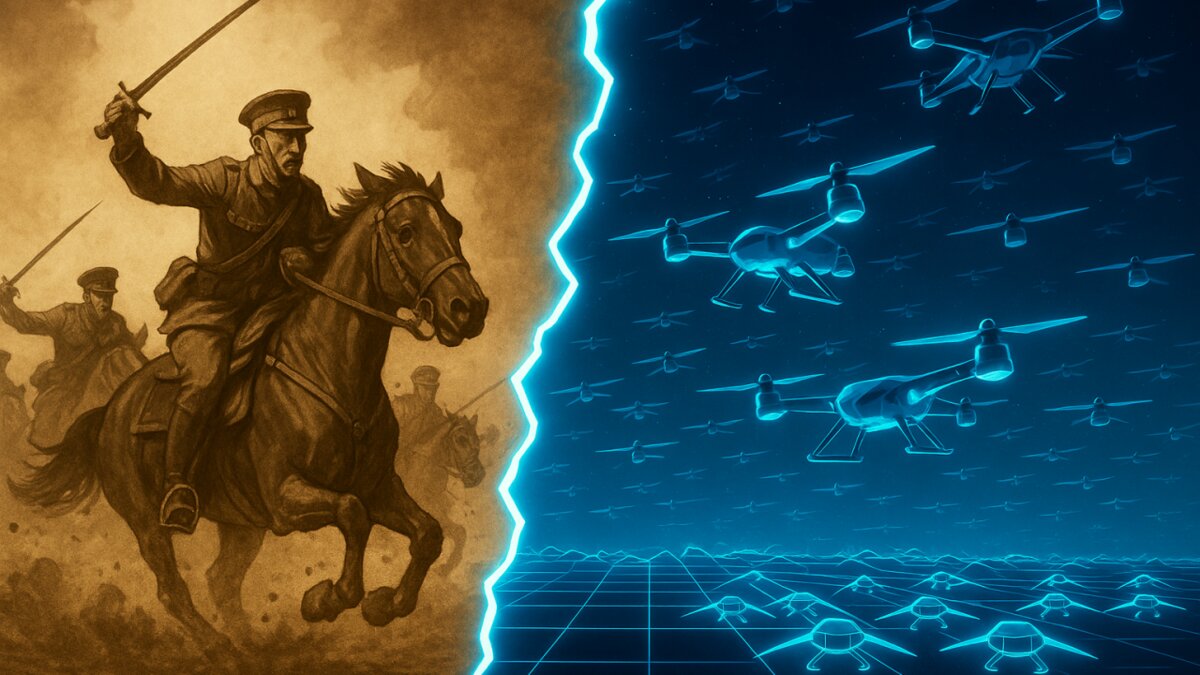
You've built something remarkable. Through vision, strategic excellence, and sheer determination, you've created or led organizations that have weathered disruptions and delivered lasting value. You understand what it takes to win.
But here's what keeps me up at night: The playbook that got us here might be the very thing that prevents us from seizing what's next.
A Story from 1940 That Should Haunt Every Leader
In May 1940, France possessed superior military technology. The French had 3,254 tanks on the northeastern front compared to 2,439 for the Germans. French tanks like the Char B1 and SOMUA S35 were rated as superior to German workhorses.
Six weeks later, France fell.
The difference wasn't technology—it was doctrine.
Much of the French armor was distributed for infantry support, with tanks moving at walking speed. Meanwhile, German doctrine stressed rapid movement, mission-type tactics and combined-arms operations. While almost 80 percent of French tanks lacked radios, German tanks were all equipped with them, enabling the flexible, coordinated movement that defined Blitzkrieg.
Here's the twist that makes this story so relevant: The French generals of 1940 had been the young officers of WWI—the ones sent over the trenches by commanders stuck in 19th-century thinking. They experienced firsthand the horror of outdated tactics. They swore "never again."
Yet when their turn came to lead, they prepared for yesterday's war, not tomorrow's. The victims of outdated thinking had become its perpetrators.
The AI Revolution Mirrors 1940
Today, I see the same pattern emerging with artificial intelligence. Most organizations are treating AI like the French treated their superior tanks—as tools to make existing processes marginally better:
- Chatbots handling 20% more customer inquiries
- Code assistants speeding up routine programming
- Document automation saving a few hours per week
These are valuable improvements. But they're the equivalent of using superior tanks to support infantry at walking speed.
Meanwhile, AI-native organizations are executing a modern Blitzkrieg. They're using AI to:
- Compress strategic decision cycles from months to days
- Create entirely new business models that wouldn't exist without AI
- Build autonomous systems that operate at machine speed
- Orchestrate multiple AI capabilities into combined operations
L'Oréal's marketing teams have reduced concept creation time from weeks to days using AI, while developers using GitHub Copilot report that up to 40% of their code is now AI-generated. These aren't productivity improvements—they're fundamental shifts in how work gets done.
But here's what no one talks about: When one knowledge worker can generate 1,000 pages of development documentation in a week using AI, the entire system breaks. Who reviews it? Who's informed? Who ensures consistency? Who coordinates updates? Traditional workflows weren't designed for machine-speed output.
And here's a critical development most have missed: Claude Opus 4 recently completed a 7-hour autonomous coding session at Rakuten, maintaining perfect consistency throughout. METR's landmark report on AI task horizons predicted we wouldn't see day-long AI performance until 2028. Yet here we are in 2025, with AI already sustaining focused work for nearly a full workday.
This isn't just about speed—it's about endurance. An AI that can maintain context and quality for 7 hours doesn't need coffee breaks, doesn't get distracted, doesn't lose focus. When METR reported that AI task horizons were doubling every 7 months, they were already being conservative. The actual pace is accelerating beyond their models.
It's like asking infantry to suddenly keep pace with tanks moving at 40 kilometers per hour. The French generals who suggested this in 1940 faced fierce resistance—not because people were stubborn, but because the entire support system would collapse. Supply lines, communications, medical support—everything was built for walking speed.
The uncomfortable truth? Breaking old paradigms rarely feels good in the moment. It feels like chaos.
Understanding the Revolution
Military strategists have a concept called Revolution in Military Affairs (RMA). It describes periods when new doctrines, strategies, tactics and technologies lead to an irrecoverable change in the conduct of warfare.
AI represents an RMA for business. It's not just a better tool—it's a fundamental shift in the nature of competition. And like all revolutions, it rewards those who recognize and adapt to new realities while punishing those who cling to old paradigms.
The Wisdom Paradox
The experience of age is wisdom. Some of it is timeless—understanding people, building culture, managing risk. But some of our 'wisdom' is built on shifting sand—assumptions about speed, scale, and the nature of competitive advantage.
Consider our traditional quality systems: peer review, approval chains, governance committees. All built for human-speed outputs. When AI can produce in hours what used to take months, these systems don't just slow things down—they create bottlenecks that negate AI's advantages entirely.
True wisdom knows the difference between timeless principles (quality matters) and outdated methods (sequential review processes).
As Harvard Business Review notes, organizations need a dual approach: Transformation A optimizes today's business model, while Transformation B creates new AI-driven business models. Most organizations are stuck in Transformation A, missing the revolutionary potential of Transformation B.
Your Strategic Choice
The fog of war is real. Today's AI landscape is confusing, filled with both genuine breakthroughs and snake oil. It's tempting to play it safe with incremental improvements where the ROI is clear.
But safety is an illusion. By the time the landscape clarifies, the revolution will be over.
Consider the timeline compression: METR's careful analysis predicted AI wouldn't achieve day-long task performance until 2028. Claude Opus 4 is already there. If the experts' conservative predictions are being shattered this quickly, what does that mean for your 3-year digital transformation roadmap?
The challenge isn't just adopting AI—it's rebuilding your entire operational system for machine speed. Quality control, decision rights, information flow, coordination mechanisms—all must be reimagined.
This is why incremental adoption feels safer but ultimately fails. You can't run Blitzkrieg operations with WWI logistics.
You face the same choice the French military faced in 1940:
Option 1: The Defensive Strategy
- Use AI to improve existing operations by 10-20%
- Maintain current business models with AI enhancements
- Move at the speed of organizational comfort
- Compete on traditional metrics
Option 2: The Blitzkrieg Strategy
- Reimagine your business model around AI capabilities
- Create new value propositions impossible without AI
- Build for machine speed with human judgment
- Define new competitive dimensions
Leading the Revolution
Here's what's different this time: We can see it coming. We have the chance to be the leaders who recognize the shift, who break the generational cycle of preparing for the last war.
But let's be honest: It won't feel good. When your teams start producing at AI speed, your carefully built quality systems will scream in protest. Your governance frameworks will create backlogs. Your management structures will feel overwhelmed.
Every instinct developed over decades of success will tell you to slow down, to control, to return to "sustainable" pace.
This is exactly how the French generals felt when confronted with Blitzkrieg tactics. Everything they knew told them it was reckless, unsustainable, dangerous. They were right about the chaos. They were wrong about the solution.
Success requires more than adopting new tools. It demands:
- Personal engagement: Get your hands dirty with AI. You can't lead a revolution from PowerPoint.
- Dual transformation: Run parallel efforts—optimize today while inventing tomorrow.
- New frameworks: Traditional change management wasn't designed for AI-speed transformation.
- Strategic courage: Accept that some of your hard-won wisdom may no longer apply. Be willing to question fundamental assumptions.
The Choice Is Yours
History doesn't repeat, but it rhymes. In 1940, superior technology paired with outdated doctrine led to defeat. Today, we risk the same if we treat AI as merely a productivity tool.
But you've disrupted before. You've built the impossible. You understand transformation.
The question isn't whether AI will revolutionize your industry—that's already happening. The question is whether you'll lead that revolution or become its casualty.
The French generals of 1940 were capable leaders trapped by their own success. You don't have to repeat their pattern. You can be the generation that gets it right—that combines timeless wisdom with revolutionary thinking.
The future belongs to organizations that orchestrate combined human-AI forces at machine speed. It needs leaders with the courage and vision to build that future.
You've already proven you can lead transformation. Now it's time to do it again—but faster, bolder, and with AI as your force multiplier, not your crutch.
I believe you will be among those who lead this revolution. The only question is: When will you begin?