

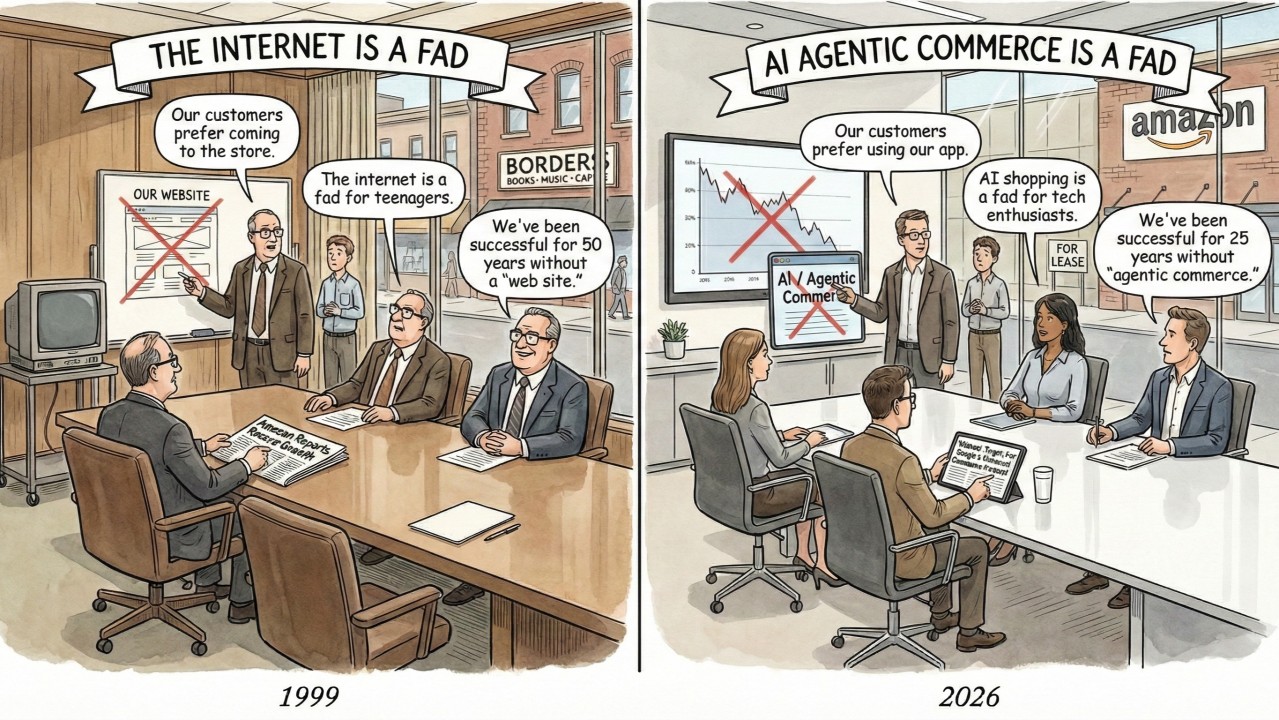
In 1999, plenty of established retailers dismissed e-commerce as a niche curiosity. "Our customers prefer stores." "We've built relationships that don't translate to websites." Some waited until Amazon had already redefined retail. Many never recovered.
That pattern is repeating, and it's moving faster this time.
On January 11, 2026, Google announced the Universal Commerce Protocol at the National Retail Federation conference. Walmart, Shopify, Target, and over 60 other companies are already onboard. The infrastructure for AI agents to discover, recommend, and purchase products on behalf of consumers has moved from PowerPoint slides to production systems.
What Just Changed
2025 saw a rapid consolidation of agentic commerce standards. In September, OpenAI and Stripe launched the Agentic Commerce Protocol. That same month, Google launched the Agent Payments Protocol with 60+ partners. By November, Perplexity had launched "Instant Buy" with 5,000+ merchants. Then in January 2026, Microsoft launched Copilot Checkout, followed days later by Google's Universal Commerce Protocol announcement.
Every major technology company is now building production infrastructure for AI-mediated commerce. They've decided that AI agents will be how people shop, and they're laying the tracks. For retail leadership, the question has shifted from "will this happen?" to "will our brand be part of it?"
AEO Is the New SEO
For two decades, Search Engine Optimization determined which brands appeared when customers searched online. Companies that mastered SEO captured organic traffic. Companies that ignored it became invisible. The equivalent for AI-mediated commerce is Answer Engine Optimization, or AEO.
When a customer asks an AI assistant "What's the best dishwasher for a family of four?" the AI doesn't return a list of links. It makes a recommendation. It answers the question. And increasingly, it can complete the purchase right there in the conversation. AEO determines whether your products are the ones being recommended.
Google's new Universal Commerce Protocol includes dozens of data attributes specifically designed for this. Brands can pre-populate answers to common customer questions, map product relationships, and train AI agents to sell effectively on their behalf. Brands that invest in AEO will have AI agents working as informed sales associates. Brands that don't will find themselves invisible in the fastest-growing commerce channel.
The Numbers That Matter
Google processed 90 trillion tokens for retailers in December 2025, an 11x increase from the year before. That kind of growth represents a real shift in how consumers are researching and buying products.
The supporting data tells the same story. Traffic driven to seller sites by generative AI grew 693.4% during the 2025 holiday season, according to Adobe. Salesforce reported that AI and agents drove approximately 20% of retail sales during the past holiday period. Gemini has 650 million monthly users. Google Search handles over a billion shopping interactions daily.
The volume is already significant and growing fast. Brands appearing in AI-mediated shopping conversations are capturing sales. Brands that aren't are losing them, often without realizing it.
The Coalition Is Already Forming
Google didn't build UCP alone. The protocol was co-developed with major retail players who recognized the strategic importance early: Shopify (enabling millions of merchants automatically), Walmart (whose incoming CEO called agentic commerce "the next great evolution in retail"), Target, Etsy, and Wayfair.
Over 60 organizations have endorsed the standard, including Visa, Mastercard, American Express, PayPal, Stripe, Best Buy, The Home Depot, Macy's, Kroger, Sephora, Ulta, and Chewy.
When your competitors and the major payment networks are building for agentic commerce, "wait and see" starts looking a lot like "fall behind."
The Parallel Is Exact
In the late 1990s, skeptical executives asked reasonable questions about e-commerce. Do our customers really want to buy online? Isn't this just for tech enthusiasts? We've succeeded without websites, so why change now?
Those questions felt prudent at the time. In retrospect, they marked the beginning of the end for brands that didn't adapt.
Today's version sounds eerily similar. Do customers really want AI buying things for them? Isn't this just for early adopters? We've succeeded without agentic commerce, so why prioritize it now?
Consumer trust in AI-completed purchases is still building. Only 17% are fully comfortable today. But that's precisely when the strategic window is open. Brands that establish trust now will own those customer relationships as adoption accelerates. Brands that wait will enter a market where competitors have already captured customer confidence and optimized their AI presence.
The Leadership Question
Agentic commerce belongs on the strategic agenda, not buried in IT's backlog. How your brand gets discovered, explained, and sold is changing, and that's a boardroom conversation.
Think about what happens when a customer asks their AI assistant for a product recommendation in your category. If AI agents can't find your products, accurately describe them, and complete transactions, those customers will buy from competitors instead. Not because your products are worse, but because your products weren't part of the conversation.
The executives who dismissed websites in 1999 weren't foolish. They were applying reasonable assumptions from an era that was ending to circumstances that required new thinking. The same risk exists today.
The Line in the Sand
Google's Universal Commerce Protocol announcement marks the moment agentic commerce graduated from conference keynote to commercial infrastructure. The major retailers and payment networks have committed, and the protocols are running in production.
Saying "we don't know or care about agentic commerce" in 2026 sounds a lot like saying "we don't need a website" in 2000. It might feel like a reasonable position right now. It won't age well.
The infrastructure is live, the coalition keeps growing, and the early movers are already optimizing. The question is whether your brand will be part of it, or whether you'll be explaining to your board in 2028 why you're playing catch-up.
Agentic Solutions helps retail brands prepare for agentic commerce, from strategic assessment to implementation. If your leadership team needs to understand what UCP, AEO, and agentic commerce mean for your business, start the conversation or reach us at amplify@agentic.solutions.