

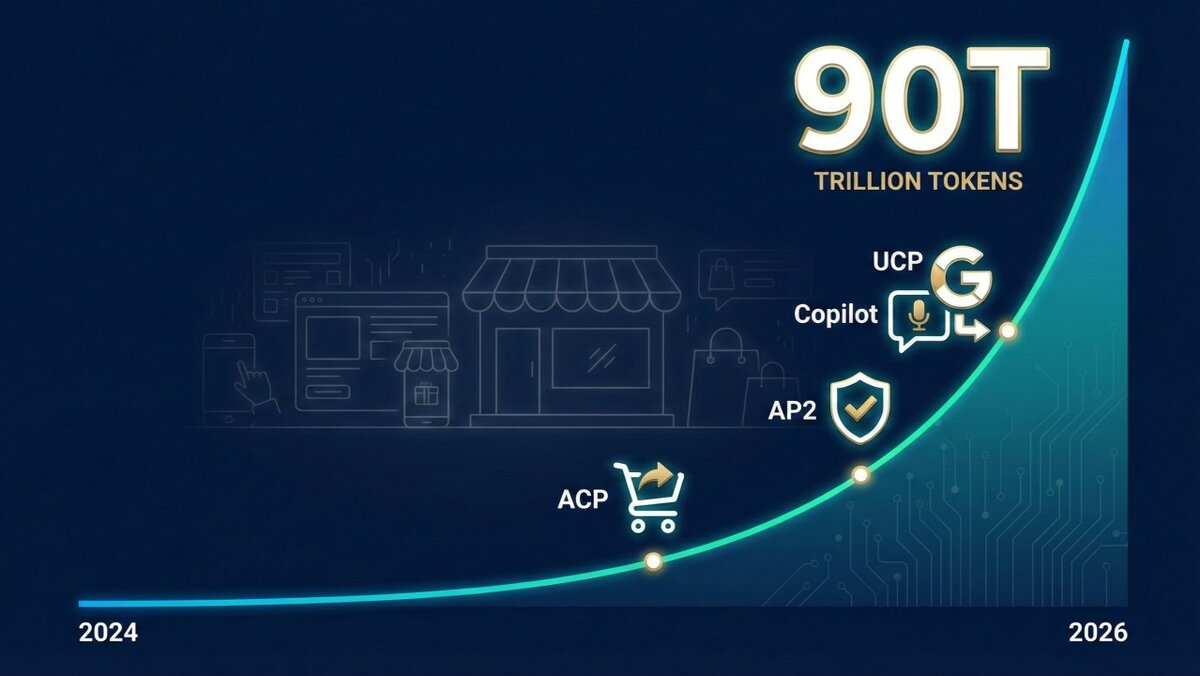
Tokens measure AI processing units. When customers interact with AI assistants about products, search for recommendations, or complete purchases through conversational commerce, they consume tokens.
Google processed 90 trillion tokens for retailers in December 2025, compared to 8.3 trillion a year prior—an 11x increase representing one of the fastest adoption curves in retail technology history.
A typical product research conversation consumes 2,000-5,000 tokens, suggesting tens of billions of AI-assisted shopping interactions monthly through Google alone. Other providers including OpenAI, Microsoft, and Perplexity process substantial additional volumes.
Supporting Evidence
Adobe reported 693.4% growth in AI-driven traffic during holiday 2025. Salesforce found AI and agents drove approximately 20% of retail sales during the same period.
This isn't a trend to watch—it's a transformation already underway.
The Protocol Landscape
Five major protocols launched in 2025-2026, each representing different approaches to AI-mediated commerce:
Agentic Commerce Protocol (ACP)
Launched: September 2025 via OpenAI and Stripe partnership
Focuses on standardized checkout for unauthenticated purchases. Risk signals flow to Stripe rather than merchants directly. Designed for ChatGPT and OpenAI-powered assistants.
Agent Payments Protocol (AP2)
Launched: September 2025 from Google with 60+ partners including Visa and Mastercard
Uses cryptographic "mandates" as verifiable consent credentials for autonomous transactions. Integrated with Google's AI shopping experiences.
Perplexity Instant Buy
Launched: November 2025 exclusively through PayPal
Available with 5,000+ merchants including Wayfair and Abercrombie & Fitch. Enables purchase completion within Perplexity's AI search interface.
Microsoft Copilot Checkout
Launched: January 8, 2026
Adopted OpenAI's ACP standard with 192,000+ products at launch through partnerships with PayPal, Shopify, Stripe, and Etsy.
Universal Commerce Protocol (UCP)
Launched: January 11, 2026 at NRF
Co-developed with Shopify, Walmart, Target, Etsy, and Wayfair. Addresses the entire shopping journey: discovery, negotiation, checkout, and post-purchase support.
Consumer Trust Reality
Research reveals significant skepticism about AI-completed purchases:
- ChannelEngine: Only 17% of shoppers comfortable with AI completing purchases
- IAB: Only 46% fully trust AI recommendations, with 89% verifying before buying
- Acosta Group: Only 12% trust AI to make purchases on their behalf
However, early adopters represent higher-value customers—more tech-forward, higher income, and influential in their networks. They're worth capturing even if the mass market follows more slowly.
Answer Engine Optimization (AEO)
AEO differs fundamentally from traditional SEO. Rather than returning ranked link lists, AI assistants make direct recommendations and can complete purchases within conversations.
Brands never appear if products lack rich, structured data. Key inputs include:
- Product data structure with explicit attributes
- Comprehensive question-answer information
- Compatible accessory mapping
- Consumer notice compliance
Brands leaving these attributes empty risk invisibility in this emerging channel.
Google Business Agent
Launching January 12, 2026, Google Business Agent allows retailers to train virtual sales associates on brand-specific data. Initial partners include Lowe's, Michaels, Poshmark, and Reebok.
This addresses brand dilution concerns by enabling brands to control their narrative in Search conversations. Your trained agent represents your products with your expertise, not generic AI responses.
UCP Implementation Requirements
Minimum technical requirements:
- Three REST endpoints (create, update, complete checkout sessions)
- Published business profile declaration
- Configured webhooks for order status updates
Shopify merchants receive automatic enablement through native integration.
The payment architecture uses a "trust triangle": merchants maintain existing payment provider relationships, platforms tokenize payment data, and platforms pass opaque tokens to merchants—keeping merchants outside PCI-DSS scope.
Product Restrictions
UCP checkout currently excludes:
- Subscriptions and installment payments
- Customized goods and pre-orders
- Age-restricted products
- Digital goods and rentals
Multi-item carts and loyalty integration remain "in development."
The Disintermediation Risk
Brands lose direct site traffic when transactions occur within AI interfaces, potentially reducing cross-selling opportunities that typically generate 33-76% of upsells.
However, non-participation guarantees invisibility. Participation provides some control over product presentation. The choice isn't whether to participate—it's how strategically you do so.
Priority Actions for 2026
1. Product Data Enrichment
Populate common question answers, map accessory relationships, create substitute mappings, rewrite descriptions for AI consumption.
2. Merchant Center Optimization
Utilize new Google attributes for Gemini and AI Mode integration.
3. Technical Readiness Assessment
Scope UCP implementation requirements for your specific infrastructure.
4. Business Agent Evaluation
Consider training investment for Search presence control.
5. Competitive Monitoring
Track competitor visibility in AI shopping responses.
Strategic Implications
Early movers building AI commerce advantages will compound benefits before market maturity solidifies. The strategic window for establishing position is narrowing as major players optimize their presence.
Waiting for additional clarity risks entering markets after competitors have captured early-adopter relationships.
Ready to assess your AI commerce readiness? Our team can evaluate your current product data, technical infrastructure, and competitive positioning.